







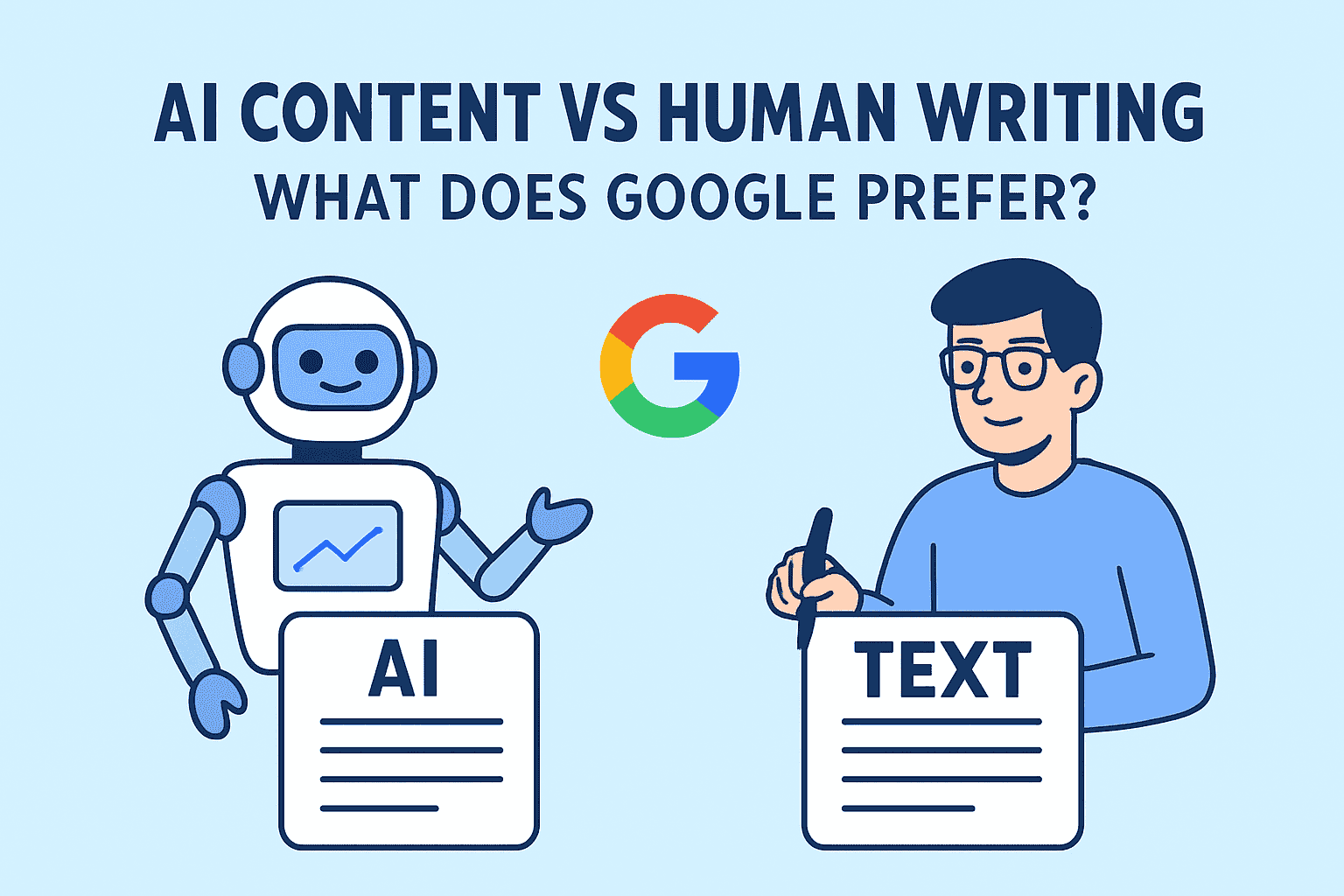
AI Content vs Human Writing: What Does Google Prefer?
The rise of artificial intelligence has transformed the way content is created. From blog posts and product descriptions to emails and ad copy, AI tools are now capable of generating content in seconds. While this efficiency has reshaped digital marketing, it has also raised an important question for businesses and marketers alike: Does Google prefer AI-generated content or human-written content?
Understanding Google’s stance on AI content is critical for maintaining rankings, authority, and long-term visibility. As algorithms become more sophisticated, quality, not the method of creation, has become the deciding factor. Let’s break down what Google truly values and how businesses can strike the right balance between AI and human creativity.
Google’s Official View on AI-Generated Content
Google does not automatically penalize AI-generated content. Instead, it focuses on content quality, relevance, and usefulness. According to Google’s Search Central guidelines, content should be created for people, not just for search engines. This means AI content can rank well if it genuinely helps users, answers their questions, and delivers value.
However, AI-generated content becomes problematic when it is:
- Mass-produced without originality
- Keyword-stuffed or manipulative
- Factually inaccurate
- Lacking depth or real insight
This is why many brands rely on strategic guidance from the best digital marketing firm in Noida to ensure AI is used responsibly, enhancing content rather than replacing thoughtful human input.
Strengths of AI-Generated Content
AI content tools offer several advantages, especially for businesses looking to scale content production.
1. Speed and Efficiency
AI can generate articles, outlines, and drafts in minutes, allowing brands to maintain consistent publishing schedules.
2. Data-Driven Optimization
AI tools can analyze keywords, search intent, and competitor content to create SEO-friendly drafts aligned with current trends.
3. Cost-Effective Scaling
For large websites or e-commerce platforms, AI helps produce content at scale without excessive resource investment.
4. Idea Generation
AI excels at brainstorming topics, structuring content, and suggesting angles that might otherwise be overlooked.
Despite these strengths, AI still lacks one crucial element-human experience.
Why Human Writing Still Matters to Google
Human-written content brings emotional intelligence, creativity, and real-world understanding, qualities that search engines increasingly reward.
1. Experience and Expertise (E-E-A-T)
Google’s ranking system emphasizes Experience, Expertise, Authoritativeness, and Trustworthiness. Human writers can share firsthand insights, opinions, and expertise that AI simply cannot replicate.
2. Original Perspective
Humans offer unique viewpoints, storytelling, and nuanced analysis that makes content more engaging and trustworthy.
3. Emotional Connection
Readers connect with content that feels authentic and relatable. Human writing builds trust, encourages longer reading times, and increases engagement signals.
4. Contextual Understanding
Human writers understand cultural references, emotions, and intent better, resulting in more meaningful and relevant content.
For long-term SEO success, especially when delivering best SEO services, combining human insight with technical optimization remains essential.
AI vs Human Writing: What Performs Better for SEO?
The truth is neither AI nor human writing wins alone. Google does not choose sides based on who created the content. Instead, it evaluates:
- Content usefulness
- Accuracy and depth
- User engagement
- Search intent fulfillment
- Credibility and originality
AI content can rank well for informational queries when edited and refined by humans. Meanwhile, human-written content often performs better for thought leadership, brand storytelling, and experience-driven topics.
The highest-performing content today uses AI as an assistant, not a replacement.
Best Practices for Using AI Content Without Hurting Rankings
To align with Google’s expectations, businesses should follow these best practices:
1. Use AI for Drafting, Not Publishing
AI should support research, outlines, and first drafts, final content must be reviewed and refined by humans.
2. Add Human Experience
Include examples, opinions, case studies, and real-world insights to strengthen credibility.
3. Focus on Search Intent
Content must answer user questions clearly and comprehensively.
4. Avoid Content Automation Abuse
Mass-producing low-quality pages can trigger algorithmic penalties.
5. Optimize for Quality, Not Quantity
Fewer high-value pages outperform hundreds of thin AI-generated articles.
How Google Detects Low-Quality AI Content
Google uses advanced machine learning to evaluate patterns such as:
- Repetitive phrasing
- Lack of semantic depth
- Poor readability
- Absence of original insight
Content that feels robotic or shallow may struggle to rank, regardless of keyword optimization.
The Future: AI and Human Collaboration
The future of content marketing lies in collaboration. AI will continue to improve efficiency, while humans will remain essential for creativity, strategy, and trust-building.
Brands that combine AI speed with human expertise will gain a competitive advantage, creating content that both search engines and users love.
Conclusion
So, what does Google prefer: AI content or human writing? The answer is simple: Google prefers high-quality, helpful, user-focused content, regardless of how it’s created. AI can support scalability and optimization, but human creativity, experience, and judgment are irreplaceable.
At Digi Global Tech, we believe in using AI responsibly that enhances content quality while preserving authenticity and search credibility. When used strategically, AI and human writing together can drive sustainable growth, stronger rankings, and meaningful engagement.
